
Planning a business trip to Shenzhen
Most of what decides whether the flight was worth it is settled before you board: who has already quoted, how you get in, and how you will pay.
Published · 13 min read · By YCP Team
On this page
- Start with the factories, not the flight
- Entry: four routes, and which one your passport is on
- Arriving: Bao'an airport, or through Hong Kong
- Getting around, and paying with a foreign card
- Where to stay, and the 24-hour registration rule
- Interpreters: hire your own, and brief them in writing
- Market days, show days and factory days
Start with the factories, not the flight
The most expensive way to run a sourcing trip is to fly out first and start the conversation on arrival. A factory seeing your specification for the first time across a meeting table can show you its showroom; one that has already priced it can show you the line, the components and the questions its engineers raised while quoting.
So plan the trip backwards from the quotes. Before you book, post an RFQ on YCP: the product, the quantity for the first order, the destination country and, if you have one, a target price. The brief goes to factories that make the product, without your company name on it, and the quotes come back through YCP, priced at your quantity. The form creates your buyer account as you go, and the brief goes live once you confirm your email address.
Use the quotes to choose which factories earn a day of the trip, and write down for each one what the visit has to establish: that the quoted capability exists, who you will actually deal with, and what you still need to see with your own eyes. A visit with a question attached is a day well spent; one without is a tour.
YCP does not arrange flights, hotels, airport pickups, drivers or interpreters. Everything below is what a buyer arranges for themselves, with the rules as they stood when this page was checked in October 2026.
Entry: four routes, and which one your passport is on
There are four ways into mainland China for a business visit. Which one applies depends on your passport and your onward ticket, so check them in this order.
Visa-free entry for up to 30 days. Ordinary-passport holders from the countries on China's unilateral visa-free list may enter for business, tourism, family visits, exchanges or transit and stay up to 30 days each time. The list keeps changing — Canada and the United Kingdom joined it from 17 February 2026 — and the arrangement is temporary: it was last extended in November 2025 and currently runs to 31 December 2026. Check the list against your own travel dates.
Mutual visa exemption. Some countries have a bilateral agreement with China instead. Singapore's has covered ordinary passports since 9 February 2024, Thailand's since 1 March 2024 and Malaysia's since 17 July 2025. Each agreement sets its own limits, so read the one that applies to your passport.
The 240-hour visa-free transit. Nationals of 57 countries, the United States among them, may enter without a visa through one of 65 designated ports and stay up to 10 days, provided they hold an ordinary passport and a confirmed onward ticket to a third country or region. Business activities are allowed; work, study and news reporting are not. In Guangdong the permitted area is the whole province and you may leave through any open port in it, but the entry ports are specific: around Shenzhen they include Bao'an airport, Shekou ferry port and the high-speed rail station at West Kowloon in Hong Kong — not the land crossings such as Lo Wu or Futian.
A business visa. If none of these fits, the usual route is an M visa, issued for commercial and trade activities. The application needs an invitation from your trade partner in China or from a trade fair, with a copy of the inviting company's business licence; the letter names you, gives your dates and the places you will visit, and carries the company's stamp. Ask the factory for it early.
Two details catch people out. Crossing into Hong Kong and back during the trip is a fresh entry into the mainland each time, so a single-entry visa does not cover it, whereas visa-free entry counts each stay separately. And since 20 November 2025 the arrival card can be completed online before you fly, on the National Immigration Administration's website or app or its WeChat and Alipay mini-programs; it can still be filled in at the port.
Arriving: Bao'an airport, or through Hong Kong
Flying straight into Shenzhen Bao'an International Airport is the simplest arrival: one immigration control, and the onward options in one place. The ground transport centre beside the terminal holds the entrance to Metro Line 11, the taxi stands, the ride-hailing pickup points and the way through to the station for the Guangzhou–Shenzhen intercity railway.
Flying into Hong Kong adds a border. Hong Kong runs its own immigration control, separate from the mainland's, so you clear both, and its entry rules for your passport are its own. The land crossings keep fixed hours: Lo Wu is open 6:30 am to midnight, the Lok Ma Chau Spur Line (the Futian crossing) 6:30 am to 10:30 pm, Shenzhen Bay 6:30 am to midnight and Heung Yuen Wai (Liantang) 7 am to 10 pm. The Lok Ma Chau control point used by the cross-boundary shuttle buses to Huanggang runs 24 hours, which matters if your flight lands late.
The cross-border high-speed rail avoids the walk: at West Kowloon station both sides' immigration checks take place inside the Hong Kong station, between 6:30 am and 11:30 pm.
And a passenger connecting from a flight at Hong Kong International Airport can take a SkyPier ferry to Shekou or Fuyong in Shenzhen, or Humen in Dongguan, without passing through Hong Kong immigration at all. It has to be the same day, with your arrival boarding pass and a ferry ticket bought in the transfer area; once you have cleared Hong Kong immigration you cannot go back to the ferry.
Getting around, and paying with a foreign card
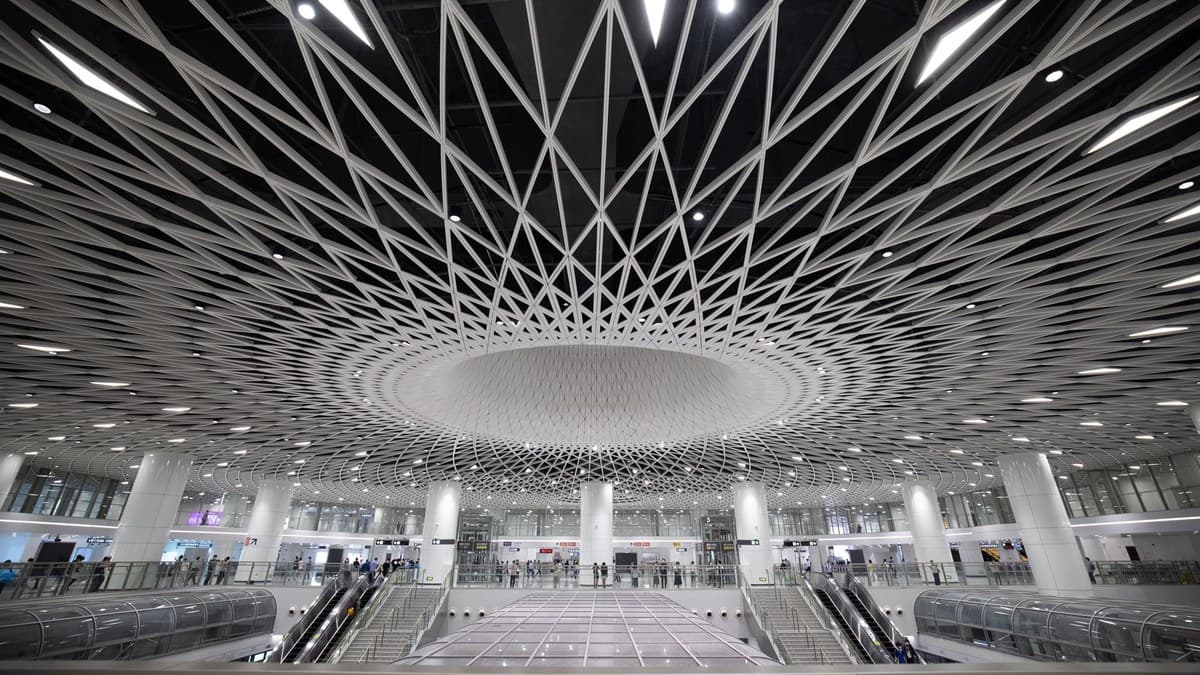
The metro is the easiest way across the city, and since 10 September 2026 it no longer needs a local card or app. Every gate at all 432 stations on the 17 lines of the Shenzhen Metro accepts a tap of a contactless UnionPay, Visa, Mastercard, American Express or JCB card, or a phone carrying one; the fare is converted and charged automatically. The card must have contactless and small-amount, no-PIN payment switched on.
For everything else, set up the payment apps before you fly. WeChat, Alipay and the UnionPay app all register with a foreign mobile number and take a linked Visa, Mastercard, UnionPay, American Express, JCB, Diners Club or Discover card once the issuing bank approves the link. Card brands, limits and fees differ between the apps, and the fees are real: in May 2026 Tencent announced a 90-day waiver of the 3% transaction fee for first-time users who link an international card to WeChat, on spending of up to RMB 1,000 a day. Read the confirmation screen before you pay.
Some home wallets work directly by scanning a merchant's QR code. The government's 2025 guide for business visitors lists, among others, Touch 'n Go eWallet from Malaysia, Changi Pay and OCBC from Singapore, GCash from the Philippines, TrueMoney from Thailand, Kakao Pay, Naver Pay and Toss Pay from Korea, and AlipayHK and WeChat Pay HK.
Ride-hailing works through the same apps: book inside Alipay or WeChat, or in the Didi-Greater China app, which accepts a foreign phone number and an international credit card. Ask each supplier for its address as a location pin and paste it in; it is more reliable than spelling an address you cannot read.
Keep some renminbi as a fallback. The State Council's 2024 guidance on payment services keeps cash as the backstop and orders a continuing crackdown on businesses refusing it; ATMs showing your card's logo pay out yuan; and each traveller may carry up to RMB 20,000 in cash in or out of the country each time.
For a day at the Canton Fair or a meeting in Guangzhou, train tickets can be bought on China Railway's 12306 English website or app with your passport and paid with a foreign card; at the station, the passport you booked with is what you show at the gate.
Where to stay, and the 24-hour registration rule
Shenzhen is nine districts and one new area, with Dongguan and Huizhou across its northern boundary, and the central business district is rarely where your factories are. Before booking, collect every supplier's address and look at them on a map. If most of the visits sit in one district, or over the line in Dongguan, stay there and save the commute at both ends of every day.
Registration is a legal requirement, not a formality. Under Article 39 of China's Exit and Entry Administration Law, a hotel registers its foreign guests with the police itself; you show your passport at check-in. If you stay anywhere else, such as a rented flat or a friend's home, you or your host must register with the local police within 24 hours of arrival.
The National Immigration Administration began piloting online registration for these non-hotel stays on 20 March 2026, but in seven provincial-level regions only, and Guangdong is not one of them. In Shenzhen it still means a visit to the police station. Failing to register can bring a warning and a fine.
When you book a hotel, ask whether it takes your card: the government's own guide for visitors advises checking in advance whether Visa, Mastercard or other international cards are accepted.
Interpreters: hire your own, and brief them in writing
If you and your counterpart do not share a working language, an interpreter decides whether a meeting is a negotiation or a guess. The supplier's English-speaking salesperson is not one. They work for the supplier, they will summarise rather than translate, and they will decide what you need to hear.
For the days that matter, hire your own and brief them in writing before the first meeting: the product, the specification, the terms you will use and the questions you mean to ask. An interpreter who has read the specification beforehand translates the numbers; one who meets it on the factory floor paraphrases them.
Ask for translation, not summary. A ten-second answer to a two-minute question means something was left out, and it is usually the condition. Keep the decisions with you: the interpreter carries words, not positions.
Treat what the interpreter hears as confidential. If the specification or the price is sensitive, put a written confidentiality undertaking in place, as you would with anyone else who sees them.
YCP does not book interpreters, and no rate is given here: it depends on the city, the subject and the length of the day, and a figure printed in a guide would be stale before the trip.
Market days, show days and factory days
A productive week mixes three kinds of day, and each has its own guide on this site, so what follows is the order rather than the detail.
A morning in the Huaqiangbei electronics market is reconnaissance: what exists, at what tier, and what a component costs this month. It is not where a specified, certified order gets placed.
A trade-show day is for finding suppliers you did not know about and seeing a whole category in one hall. Whether a show is worth timing the trip around depends on which of those you need; the Canton Fair is in Guangzhou, a train ride away.
Factory days are the point of the trip. Plan them by district or town rather than by city, put factories that are close together on the same day, and go in with the question you wrote down when you read their quote. What to look at on the floor, and what a visit can never prove, is in our guide to visiting a factory.
Keep the last day for follow-up: the questions that came out of the visits, the samples to arrange and the quotes to revise. A trip that ends on the way to the airport takes every open question home with it.
Questions people actually ask
Do I need a visa for a business trip to Shenzhen?
It depends on your passport. Ordinary-passport holders from countries on China's unilateral visa-free list can enter for business and stay up to 30 days per entry, under a temporary arrangement that currently runs to 31 December 2026. Singapore, Thailand and Malaysia have mutual visa-exemption agreements. Nationals of 57 countries can use the 240-hour visa-free transit when flying on to a third country or region. Otherwise the usual route is a business (M) visa, supported by an invitation from the Chinese company or a trade fair.
Can I use the 240-hour visa-free transit for a business trip?
Yes, if you qualify: business activities are permitted, while work, study and news reporting are not. You need an ordinary passport from one of the 57 eligible countries and a confirmed onward ticket to a third country or region, and you must enter through a designated port. Around Shenzhen that means Bao'an airport, Shekou ferry port or the West Kowloon high-speed rail station in Hong Kong, not the land crossings. You may then stay up to 10 days anywhere in Guangdong.
Should I fly into Shenzhen or Hong Kong?
Bao'an is simpler: one immigration control, and the metro, taxis and ride-hailing all start from the ground transport centre beside the terminal. Hong Kong adds a second border, and most land crossings close overnight, although the Lok Ma Chau crossing used by the shuttle buses to Huanggang runs 24 hours. If you are connecting from a flight at Hong Kong airport, a SkyPier ferry to Shekou or Fuyong skips Hong Kong immigration altogether, on the same day only.
Can I pay with Visa or Mastercard in Shenzhen?
Increasingly, yes. Since 10 September 2026 every Shenzhen Metro gate accepts a tap of a contactless UnionPay, Visa, Mastercard, American Express or JCB card. Alipay and WeChat take a linked foreign card, with limits and fees that differ between the apps, and ATMs showing your card's logo pay out yuan. Carry some cash as a fallback.
Do foreigners have to register with the police in Shenzhen?
Yes. A hotel registers you itself when you check in with your passport. If you stay anywhere else, you or your host must register with the local police within 24 hours of arrival. Online registration for those stays is being piloted in seven provincial-level regions that do not include Guangdong, so in Shenzhen it still means the police station. Failing to register can bring a warning and a fine.
Should the factory's English-speaking staff interpret for me?
For small talk, yes; for anything that decides a price or a specification, hire your own interpreter. The supplier's staff work for the supplier and tend to summarise rather than translate. Brief your interpreter in writing beforehand, ask for translation rather than summary, and keep the decisions with you.
Does YCP arrange airport pickup, hotels or interpreters?
No. YCP is a B2B marketplace that connects buyers with Chinese factories, and it does not book travel, drivers or interpreters. What it can do before you fly is put your RFQ in front of factories that make the product, so the ones you visit have already quoted.