
CBM, container sizes and what actually fits
A carton five millimetres too wide costs you a whole row, for the length of the box.
Published · 8 min read · By YCP Team

On this page
The calculation, and the dimensions people get wrong
Measure the packed carton in metres — length by width by height — and multiply. Multiply that by the carton count and you have the shipment's volume. A forwarder will usually want the volume, the gross weight and the carton count together, because the three of them decide which of the limits below binds.
Use the outside of the FULL carton. A box specified at a given size is flat when it is ordered and swollen when it is packed: goods press the walls out, tape adds a little, and the carton that actually stacks is measurably larger than the one on the drawing. That difference is the single commonest reason a supplier's CBM and a forwarder's CBM disagree, and the forwarder is measuring the real object.
Measure the tallest, widest, deepest point rather than the nominal face. A carton with a bulge is not stackable to its flat dimension: whatever sticks out is what sets the pitch of the stack, and the space you lose is real even though the drawing says otherwise.
Do not calculate from the product. A product volume tells you nothing useful — it is the inner packing, the divider, the void fill and the outer carton that ship. And this is where the money is hiding: for a light, bulky product the packaging is very close to the entire freight cost, and it is decided by whoever specified the carton.
Ask the supplier for the carton dimensions and the pieces per carton at quotation stage, in writing, and have them confirmed against a real packed carton before production ends. The pre-shipment inspection measures the carton and weighs it — which is the moment the number stops being a claim.
Three ways to run out, and only one of them is volume

Volume. The obvious one, and for most light consumer goods the one that binds. If you are shipping something bulky and light, you will fill the space long before you approach any weight limit, and the whole game is carton efficiency.
Weight. Every container has a maximum gross mass and a tare, and the difference is the payload. But the container's own rating is frequently NOT the binding limit — the road behind it usually is. Legal axle and gross vehicle weights at the destination, and any port or terminal limits, can cap a container well below what it could physically carry, and they differ by country and sometimes by route. No figures are published here for exactly that reason: ask the haulier at the destination what they can legally lift, before you plan the load.
Tiling. The one nobody models. Cartons do not fill a rectangular floor unless their footprint divides into it, and a carton a few millimetres too wide loses an entire row for the whole length of the container. The lost space is not a rounding error; it is one column of cartons multiplied by the number of tiers, and it recurs on every container you ever ship of that product.
Pallets change the arithmetic again and usually not in your favour. A palletised load costs you the pallet's own height on every tier and whatever overhang or shortfall the pallet footprint creates against the container width. Palletising buys handling speed, damage protection and, in some destinations, faster unloading — so it is a real trade, but it is a trade, and it should be priced rather than assumed.
The practical order of operations: get the real packed carton dimensions, ask the forwarder how those tile into the container they will actually give you, then decide whether a small change to the carton pays for itself. It usually does, and it is free before the tooling for the box is cut.
"The capacity of a 20-foot container" is a nominal figure, not a measurement
Every freight blog publishes the same two numbers for the usable volume of a twenty-foot and a forty-foot container. They are useful as a rough planning figure and they are not a fact about the box you will be given, and the reason is in the standard itself.
ISO 668, "Series 1 freight containers — Classification, dimensions and ratings", establishes its classification "based on external dimensions", and specifies "where appropriate, the minimum internal and door opening dimensions for certain types of containers". Minimum. The standard that defines what a shipping container IS pins down the outside precisely — because the outside has to fit ships, cranes and chassis anywhere in the world — and puts only a floor under the inside.
ISO goes further and names where the real answer lives: "the dimensions of each type of container are defined in the appropriate part of ISO 1496, which is the authoritative document for internal container dimensions". So the internal volume depends on the type and on the build — wall thickness, corrugation depth, flooring, and whether it is a standard-height or a high-cube box.
This page therefore publishes no capacity table, and the omission is the advice. A number here would be planned around; what you want instead is the actual internal dimensions and the actual payload of the actual container, which the carrier can give you and which is marked on the unit itself. Ask for it whenever the load is close to any limit — that is the whole population of loads where the answer matters.
And check the edition anyone cites at you. ISO 668:2013 has been withdrawn and replaced by a 2020 edition. A specification, a purchase order or a guide quoting the 2013 or 1995 text is quoting a withdrawn document, which is worth catching before it is written into a contract.
Design the carton to the container, not the other way round
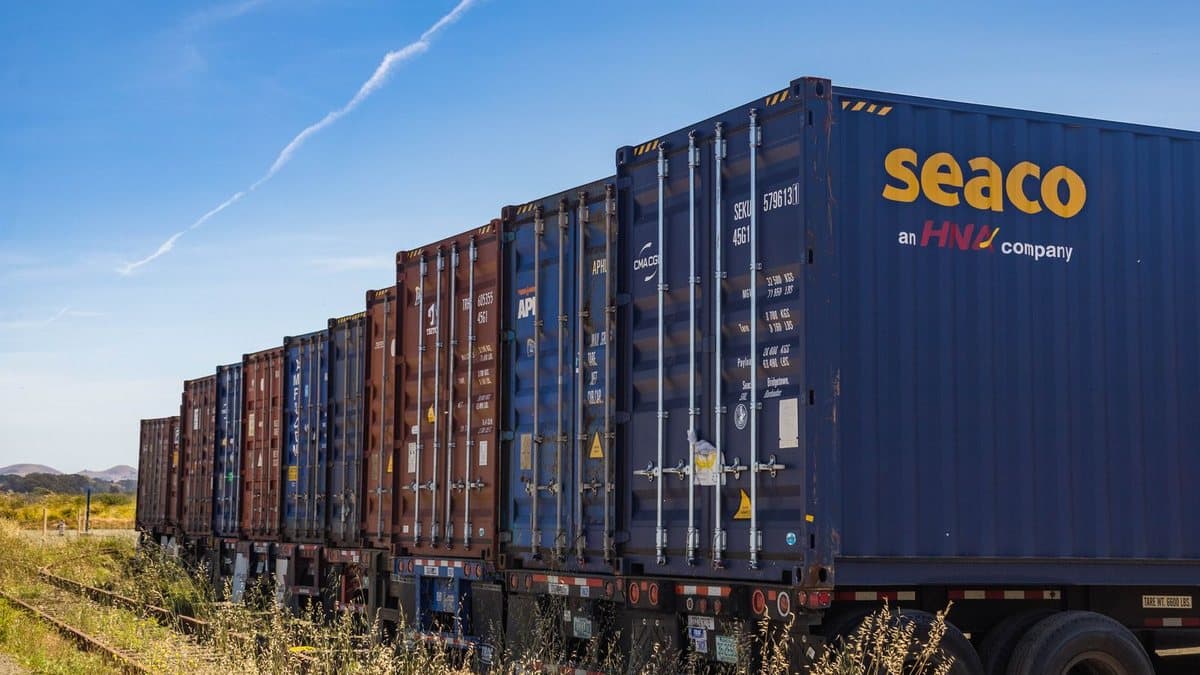
This is the free money in the whole subject, and it is available exactly once — before the carton is finalised. Take the internal width and length of the container you will actually use, and work backwards to a carton footprint that tiles into it with as little waste as possible. Then check that the resulting stack height also divides sensibly into the internal height.
Small changes are worth a surprising amount. Shaving a few millimetres off a carton's width, or turning the pack orientation so the long side runs across the box instead of along it, can add a whole column. The change costs nothing at the design stage and is nearly impossible later, because the die for the carton, the inner packing, the artwork and the case count all move together.
Fix the pieces per carton at the same time and for the same reason. It sets the carton size, the gross weight per carton — which decides whether one person can lift it and therefore how it is handled at every stop — and your minimum shippable increment. A case count chosen for the freight is a different number from one chosen for the shelf, and if both matter, the conflict is better found now.
Then write the packed carton dimensions, the pieces per carton, the net and gross weight and the carton material into the purchase order as specifications rather than as an appendix. Suppliers change carton sizes between runs for perfectly ordinary reasons — a different box supplier, a material substitution, a slightly larger inner tray — and a change of a few millimetres that nobody flagged reappears as a container that will not close.
Where the goods are combined from several factories, the carton discipline matters more, not less: mixed sizes tile far worse than one size, and a consolidator cannot fix on the day what the specification made impossible months earlier.
Questions people actually ask
What is CBM in shipping?
Cubic metres. Multiply the length, width and height of a packed carton in metres, then multiply by the number of cartons. Use the outside of the full, sealed carton as it will actually stack — including any bulge — not the flat dimensions of the box as ordered and not the product.
How many CBM fit in a 20-foot container?
There is no single honest number, which is why this page does not print one. ISO 668 classifies containers "based on external dimensions" and specifies only the minimum internal dimensions; ISO names ISO 1496 as "the authoritative document for internal container dimensions". Usable volume varies with the type and the build. Ask the carrier for the actual internal dimensions and payload of the container you are being given, whenever the load is near a limit.
Why does my supplier's CBM not match the forwarder's?
Usually because the supplier calculated from the ordered carton size and the forwarder measured the packed carton. A full box bulges, tape adds thickness, and the object that stacks is larger than the drawing. The forwarder is measuring the real thing, and the difference is charged.
What limits a load first — weight or volume?
Whichever you reach first, and for most light consumer goods it is volume. But the binding weight limit is often not the container's rating: legal axle and gross vehicle weights on the road at the destination, and port or terminal limits, can cap the load well below what the box could carry. They vary by country and route, so ask the destination haulier before planning the load.
Is CBM the same as chargeable weight?
No. CBM is a measurement of volume. Chargeable weight is a pricing rule that compares your volume against your actual weight and bills the greater, and each mode applies it differently. Two shipments with identical CBM can be priced very differently if one is dense and the other is not.
Should I palletise?
It is a genuine trade rather than an upgrade. Pallets buy handling speed, damage protection and faster unloading in some destinations, and they cost you the pallet's height on every tier plus whatever overhang the footprint creates against the container width. Price it against the volume it takes rather than assuming it.