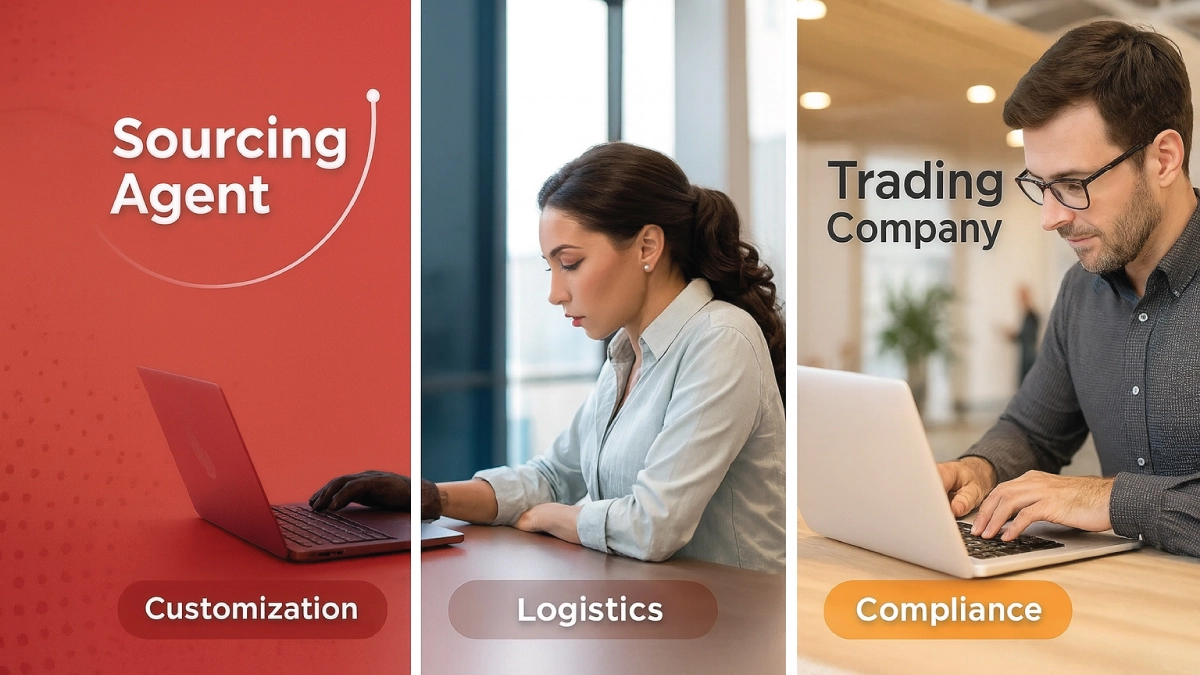
If your company is sourcing products internationally, you’ve likely faced the question of whether to use a sourcing agent vs trading company. The choice affects everything from unit cost, quality consistency, lead times and how smoothly your supply chain runs. Pick the wrong model and you risk delays, hidden markups and defects; choose well and you reduce risk, gain transparency, and scale faster.
In this guide, YourChinaPartner breaks down the real-world differences between a sourcing agent and a trading company, explains how incentives and accountability differ, and gives you practical, step-by-step advice to match the model to your product stage, budget, and risk tolerance. You’ll learn where each partner type shines, what red flags to watch for, and how to validate a partner before you commit—so you can make an informed decision that benefits your business today and as you grow.
Understanding the difference: A sourcing agent acts as your representative in the supplier market, working on your behalf to find manufacturers, negotiate prices, manage orders, and handle quality checks. In contrast, a trading company is essentially a vendor – it buys products from factories and then resells them to you at a markup. In simple terms, the agent is a service provider connecting you directly to factories, while the trading company is a middleman seller of the goods. This sourcing agent vs trading company distinction influences how you will work with each.
Step-by-step guidance:
Identify the partner’s role upfront: Ask any potential partner whether they operate as a service provider (sourcing agent) or as a product supplier (trading company). Confirm how they charge and whether you would be paying the factory directly or buying from them. (This verifies who you’re dealing with so you know what to expect from the start.)
Clarify duties and expectations: Clearly outline which tasks the partner will handle. For a sourcing agent, detail services like supplier research, factory communication, and inspections. For a trading company, clarify what services come with the product (such as handling export paperwork or packaging). Get these expectations in writing. (Spelling out duties prevents misunderstandings and ensures all sourcing tasks are covered by the appropriate party.)
Align with your working style: Decide how much involvement you want. If you want direct factory interaction and more control, working with a sourcing agent may suit you better. If you prefer a one-stop shop that delivers finished products with minimal input from you, a trading company could be more convenient. (This alignment ensures you choose the type of partnership that fits your management style.)
By taking these steps to clarify roles and responsibilities, you’ll avoid common pitfalls like hidden middlemen or unmet expectations. Both you and your partner will have a clear understanding of who does what, setting the stage for a smooth collaboration in either sourcing agent vs trading company scenario.
Understanding the difference: The cost structure is one of the biggest factors when comparing a sourcing agent vs trading company. A sourcing agent typically charges a service fee or commission (for example, around 5–10% of the order value) in exchange for managing the sourcing process. A trading company makes money by marking up the product price – it buys from the factory at a lower cost and sells to you at a higher price (often adding anywhere from 10% to 30% as their profit). With a sourcing agent, you usually pay the factory’s price plus the agent’s fee, whereas with a trading company, the fee is hidden in the higher product price. Transparency can differ: a good sourcing agent will openly tell you their commission, while a trading firm might not volunteer how much margin they’ve added.
Step-by-step guidance:
Request a detailed price breakdown: If using a sourcing agent, ask them to show the supplier’s original price and their commission separately. If dealing with a trading company, request an itemized quote and see if they will reveal the factory price. (A transparent breakdown lets you know exactly what you’re paying for and helps expose any hidden markups.)
Compare total landed costs: Consider all expenses, not just the unit price. Include the agent’s commission vs. the trading company’s margin, plus shipping, import duties, and other fees. Calculate the full cost for your order in both scenarios. (This comprehensive comparison often shows which option is more cost-effective once everything is factored in. You’ll make a financially sound choice by crunching these numbers.)
Leverage your order volume: If you have a large or repeat order, negotiate for better rates. A sourcing agent might lower their percentage for a big contract, and a trading company might give a volume discount. Make sure all fees are agreed upon upfront to avoid surprises. (Negotiating based on volume can lead to significant savings – a trustworthy partner will adjust their fees to build a long-term relationship with you, a win-win in any sourcing agent vs trading company scenario.)
By focusing on cost transparency and doing the math, you maintain control over your budget. No matter which partner you choose, understanding the pricing model of a sourcing agent vs trading company helps you avoid overpaying and protects your profit margins.
Bringing it all together: How can you tell which option is best for you? Consider these three key factors:
Step-by-step guidance:
Product complexity and order size: Consider what you’re buying. If your product is highly customized or you need help with product development and small trial runs, a sourcing agent is likely the better fit because they can work closely with manufacturers and even negotiate smaller Minimum Order Quantities. If your orders are straightforward or you need many different products in small quantities, a trading company might be more practical since they have a broad supplier network and can consolidate orders to meet factory MOQs. (Matching your needs with the right partner in the sourcing agent vs trading company equation ensures you can meet your requirements efficiently.)
Control and relationship with suppliers: Think about how much control and visibility you want. If it’s important for you to build a direct relationship with the manufacturer, have input during production (including oversight of quality), or simply know exactly who is making your product, a sourcing agent will let you do that. If you’d rather hand off the project and trust a professional to deliver results (including managing quality control) without your close involvement, a trading company’s model might suit you better. (Your comfort level with oversight versus delegation will guide you to the partnership where you’ll feel most at ease.)
Finally, whichever option you choose, remember to vet the specific partner’s credibility. Check references or reviews for the individual agent or trading firm, and consider starting with a small test order. By verifying reliability with a trial run, you can ensure that your chosen partner meets your expectations before committing heavily. By taking these precautions, you’ll know you made the right choice in the sourcing agent vs trading company debate.
Choosing between a sourcing agent vs trading company is not a one-size-fits-all decision. In summary, a sourcing agent offers more transparency, control, and potentially lower factory pricing, whereas a trading company offers simplicity and convenience by handling everything for you (at a higher per-unit cost). You should base your decision on what matters most to your business – cost savings, hands-on control, or ease of operation. By following this guidance, you can avoid common pitfalls and confidently select the option that best aligns with your needs. Ultimately, understanding the nuances of the sourcing agent vs trading company decision will help you source smarter and more confidently.
We hope this comparison has given you the clarity to move forward with your sourcing strategy. Both paths can lead to success when managed well.
Enjoyed this comprehensive sourcing agent vs trading company comparison? Follow our Facebook page, LinkedIn profile, or Instagram account for more expert insights on China sourcing, supplier verification, and quality control. If you want hands-on help—from shortlisting and factory checks to pilot runs and ongoing QC—contact YourChinaPartner for a consultation. We’ll assess your product, volume, and timelines, then recommend (and manage) the model that best fits your goals.

Reviewed and originally published by YourChinaPartner on September 26, 2025

Global HQ (Singapore)
24 Sin Ming Lane, #01-100
Singapore 573970
Shenzhen (Regional Office)
深圳市宝安区西乡街道固兴
路V都会1A505-506 (518101)